Intelerad vs Medicai for Zero-Footprint Diagnostic Viewing
Many radiology teams still load full desktop software just to open a study from another site. This adds setup time on every consult and raises the chance of version conflicts across locations.
By the final section you will know exactly how zero-footprint performance, security controls, and integration limits differ between Medicai and Intelerad, which pricing model fits your case volume, and which platform earns the verdict for your workflow.
Quick Verdict: Intelerad vs Medicai for Zero-Footprint Diagnostic Viewing
The decisive difference between Intelerad and Medicai for zero-footprint diagnostic viewing lies in their deployment models, compliance certifications, and monthly pricing tiers.
Medicai operates through a cloud PACS model that eliminates the need for on-premise servers or desktop installations. A browser-based HTML5 viewer delivers full diagnostic capabilities across any device without software downloads.
Intelerad typically requires enterprise licensing agreements that involve substantial upfront costs and lengthy implementation cycles. These contracts often suit large hospital systems with dedicated IT infrastructure and extended procurement processes.
Medicai offers a Starter plan at $249 per month that provides immediate access to diagnostic viewing tools. This predictable pricing structure removes barriers for smaller practices and independent radiologists seeking professional-grade capabilities.
Both platforms maintain HIPAA and GDPR compliance, though Medicai adds FDA and CEE cleared viewers as standard features. Security protocols follow OWASP guidelines across all system components.
Performance metrics show Medicai processes 1M+ studies yearly while maintaining 1.7M+ studies in active storage. The platform supports 300k+ visualizations and handles 50M+ yearly API transactions through its Microsoft Azure infrastructure.
Trade-offs depend on organizational scale and budget priorities. Larger enterprises may prefer Intelerad's established presence in academic medical centers, while practices seeking rapid deployment and transparent costs find Medicai's approach more practical.
At a glance: how Medicai compares to Intelerad, Medicai for Zero-Footprint Diagnostic Viewing on the features that matter most.
| Feature | Medicai | Intelerad | Medicai for Zero-Footprint Diagnostic Viewing |
|---|---|---|---|
| Zero-Footprint Diagnostic Viewing | ✓ | ✓ | ✓ |
What Is Medicai?
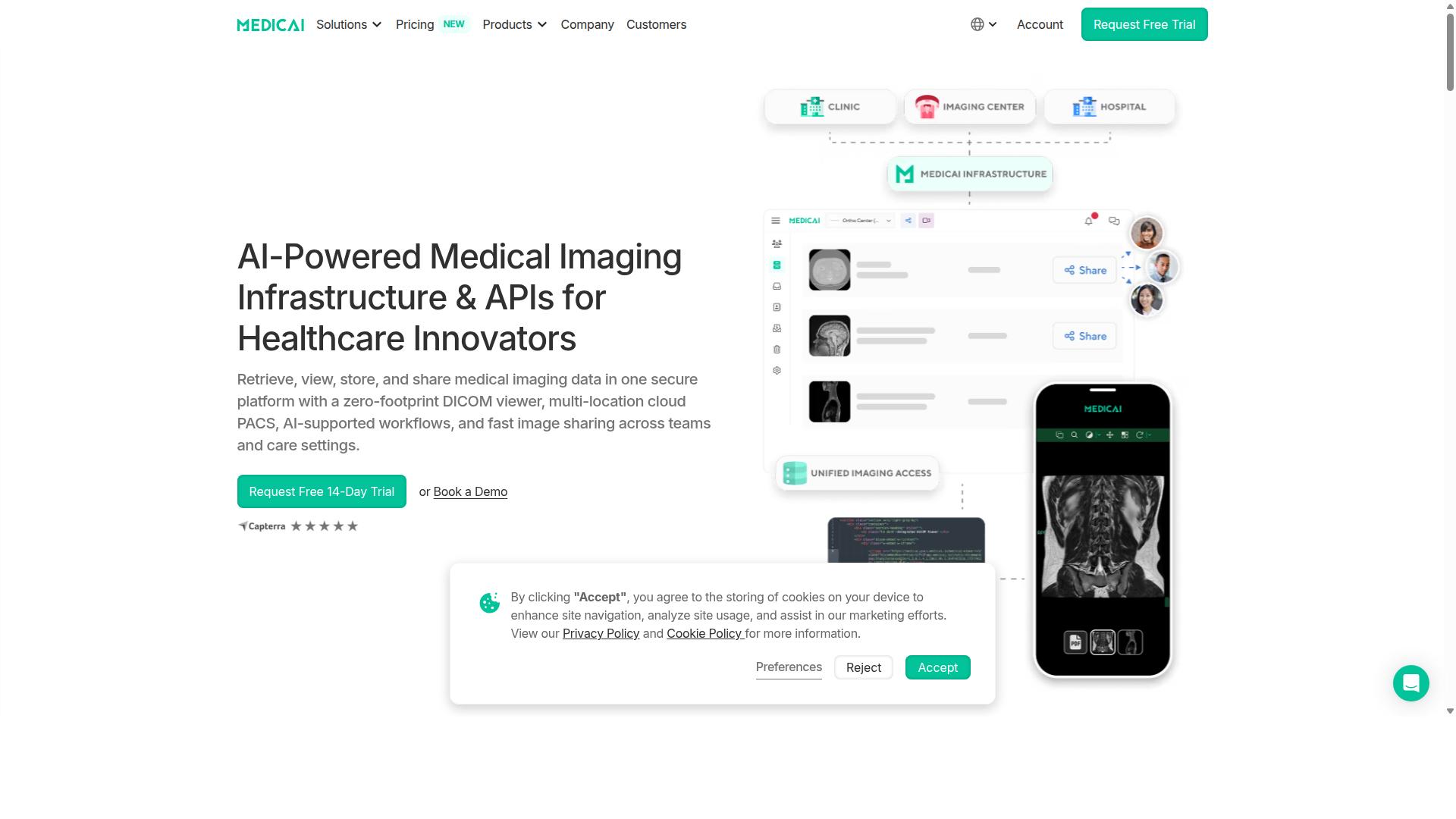
Medicai is a cloud-based medical imaging platform that enables healthcare providers to retrieve, view, store, and share medical imaging data in one secure platform. The platform provides healthcare organizations with a zero-footprint DICOM viewer that runs directly in standard web browsers without requiring software installation or maintenance.
Healthcare facilities using this solution operate within a multi-location cloud PACS infrastructure that supports AI-assisted workflows. This approach allows radiology teams to access diagnostic imaging studies across different care settings through a unified system.
The platform maintains HIPAA and GDPR compliance while holding FDA clearance and CEE certification. These regulatory approvals demonstrate adherence to industry standards for data security and patient privacy protection.
Healthcare providers benefit from integrated image sharing capabilities that connect teams across various clinical environments. The platform supports interoperability requirements while maintaining security protocols required for medical imaging operations.
What Is Intelerad?

Intelerad is an established enterprise imaging vendor known for its on-premise and cloud PACS solutions used by large health systems. Their platforms support multi-site deployments where hospitals and clinics connect through a single system for reading studies and managing reports.
Typical radiology workflows rely on worklists, study routing, and role-based access to keep images available to the right users. These tools help teams handle reading assignments across different locations without requiring local installs on every workstation.
Many enterprise imaging customers also use Intelerad for teleradiology and image distribution between sites. The system handles common DICOM formats and supports basic viewer functions such as measurements and annotations that radiologists depend on during daily reading sessions.
Deployment models range from full on-premise servers to hybrid cloud setups depending on hospital needs and regulatory requirements. Each approach includes standard security features such as encryption and audit logs that meet HIPAA compliance expectations for medical imaging environments.
Users interact with the platform through desktop applications and web-based viewers that vary by implementation. The focus remains on reliable image access and integration with existing RIS and EMR systems that most health systems already rely on for daily operations.
What Is Medicai for Zero-Footprint Diagnostic Viewing?
Medicai's zero-footprint viewer runs entirely in any modern browser via HTML5 and supports 3D reconstruction, MIP, MPR, and hanging protocols without local software. The viewer supports multi-monitor workflows directly through standard browser controls, allowing radiologists to spread images across additional displays without extra plugins or drivers. Users can adjust layout, window levels, and study comparisons from the same session, preserving speed in high-volume reading environments.
Measurement tools and image annotation are built into the viewer. Radiologists can place calipers, angle tools, and region-of-interest measurements without leaving the browser window. Annotations persist with the study, so later reviewers see the same markup and avoid repeating work.
Medicai handles more than 300,000 visualizations per year across its cloud platform. This volume demonstrates consistent performance under real clinical loads and supports departments that need reliable uptime without local hardware upgrades.
The viewer remains device-agnostic. Clinicians access studies from desktops, laptops, or tablets while the same security, encryption, and audit-log features apply. Because the application lives in the cloud PACS, no client-side installation is required and updates occur automatically for all users.
Compared with Intelerad, Medicai's browser-only approach removes the need for local viewer installs or maintenance windows. Hospitals and imaging centers that prioritize quick deployment and reduced IT overhead often find this model easier to scale across multiple sites.
Features Compared
This section breaks down the most critical feature areas where Intelerad and Medicai differ for zero-footprint diagnostic viewing.
Enterprise imaging platforms must handle large DICOM studies while maintaining responsive browser-based performance. The ability to support complex rendering tasks and connect with existing clinical systems determines which solution fits specific workflow demands.
Security standards and scalability also shape long-term viability. Organizations need platforms that meet regulatory requirements while growing with increasing study volumes and user counts.
Zero-Footprint Viewer Performance
Both platforms claim browser-based viewing, but actual speed and tool responsiveness vary across network conditions and study sizes.
Intelerad positions its solution as a web-based viewer capable of handling standard radiology workflows. Performance claims focus on general accessibility without specifying load time benchmarks or rendering capabilities under heavy clinical use.
Medicai processes 300k+ visualizations of DICOM studies in the last year through its zero-footprint viewer. This volume suggests consistent performance across varied study types and network environments.
Rendering requirements for 3D reconstruction, MIP, and MPR views demand efficient browser processing. Platforms that maintain responsive interaction with these advanced tools provide clearer diagnostic advantages during complex case review.
Hanging protocol support affects how efficiently radiologists can review studies across multiple monitors. Both solutions address this need, though implementation approaches differ in flexibility and customization options.
Security and Compliance
HIPAA and GDPR compliance plus encryption standards are non-negotiable for diagnostic imaging platforms.
Intelerad maintains general compliance posture typical of enterprise medical imaging vendors. Specific security certifications and implementation details remain less documented in public materials.
Medicai follows HIPAA and GDPR compliance requirements along with OWASP security guidelines. The platform holds FDA/CEE clearance for its viewers, meeting regulatory standards for diagnostic use in clinical settings.
Audit logs and role-based access controls form essential components of secure medical imaging systems. These features help organizations track user activity and maintain appropriate access restrictions across different user types.
Encryption standards protect patient data during transmission and storage. Platforms must implement these measures consistently to satisfy both regulatory requirements and institutional security policies.
Integration and Scalability
Enterprise imaging success depends on seamless HL7/FHIR connections to EMR, RIS, and VNA systems.
Intelerad approaches integration through standard healthcare protocols. Specific details about transaction volumes or hosting infrastructure remain general in available documentation.
Medicai supports 50M+ yearly API transactions while maintaining connections to existing clinical systems. The platform operates through Microsoft Azure, Hetzner, and AWS hosting options for geographic flexibility.
Vendor neutral archive capabilities allow organizations to consolidate imaging data across multiple departments. This centralized approach improves image distribution while reducing duplicate storage requirements.
Scalability becomes critical as imaging volumes increase across healthcare networks. Platforms must handle growing study counts without performance degradation or additional infrastructure complexity.
Pricing Compared
Transparent usage-based pricing versus traditional licensing models can shift the total cost of ownership dramatically. Organizations need to evaluate how each vendor structures payments before committing to a platform for zero-footprint diagnostic viewing.
Medicai offers monthly billing with two defined tiers. The Starter plan costs $249 per month and includes 500 GB cloud storage plus unlimited user accounts. The Standard plan costs $749 per month and provides 2 TB cloud storage with unlimited user accounts and one connected location.
Yearly billing reduces these rates by 15 percent. The Starter plan drops to $209 per month when paid annually, while the Standard plan drops to $639 per month under the same terms.
Intelerad follows a traditional licensing model with custom quotes that typically bundle software, maintenance, and support into multi-year contracts. This approach can obscure the true cost of adding users or storage over time.
Enterprise customers at Medicai receive custom pricing that scales cloud storage and connected locations to match their needs. Per-study pricing options also exist for organizations with variable imaging volumes rather than fixed storage limits.
A one-time DICOM gateway setup fee of $1,000 applies per location when connecting external sites. This cost appears once rather than recurring monthly, which keeps ongoing expenses predictable for teams managing multiple facilities.
| Plan Details | Medicai | Intelerad |
|---|---|---|
| Starter Monthly | $249 for 500 GB, unlimited users | Custom quote required |
| Standard Monthly | $749 for 2 TB, unlimited users, one location | Custom quote required |
| Yearly Discount | 15 percent savings on both tiers | Typically negotiated per contract |
| Enterprise | Custom storage and multiple locations | Enterprise licensing model |
Research suggests that predictable storage tiers help radiology departments control budgets more effectively than open-ended licensing structures. Medicai's published rates allow teams to forecast expenses without waiting for vendor negotiations.
Who Should Choose Medicai
Medicai fits organizations that need rapid deployment, predictable monthly costs, and global access without on-premise hardware.
Hospitals and imaging centers gain immediate value when they require browser-based access to diagnostic imaging across multiple departments. The $249 entry plan keeps expenses clear while the unlimited user accounts remove the need to track seat licenses.
Specialty groups in orthopedics, neurology, oncology, radiology, and cardiology often collaborate with external partners. Medicai supports these teams because it is available worldwide and accepts no-install access through any modern browser.
Additional users such as teleradiology services, tumor boards, and clinical trial coordinators can connect directly to studies without extra software. Personal injury lawyers and medical education organizations benefit from the same zero-footprint viewer when they need quick review of studies.
Virtual care providers and telemedicine platforms rely on secure image distribution. Medicai supplies the required infrastructure to these groups through its cloud platform, which scales without hardware purchases or regional restrictions.
Who Should Choose Intelerad
Intelerad is typically selected by large, multi-site health systems that already operate extensive on-premise infrastructure. These organizations often maintain dedicated IT departments and prefer established enterprise solutions that connect with existing hospital networks.
Academic medical centers represent another common user group. They frequently require complex workflow configurations that support teaching environments and research departments alongside clinical operations.
Government healthcare facilities also gravitate toward Intelerad deployments. Such institutions usually need vendor solutions that meet specific procurement requirements and operate within tightly controlled network environments.
Regional hospital networks with centralized data centers often choose this approach. These systems value the ability to maintain direct control over hardware resources and data storage locations across multiple facilities.
Organizations with mature PACS implementations frequently continue with familiar enterprise vendors. They may prioritize continuity of existing workflows over exploring newer deployment models for medical imaging access.
Who Should Choose Medicai for Zero-Footprint Diagnostic Viewing
Teams that need immediate, install-free diagnostic access from any location benefit most from Medicai's HTML5 viewer. Remote specialists and teleradiology groups often face connectivity constraints and device limitations that demand a true zero-footprint solution.
Medicai stores over 1.7 million studies in its cloud PACS architecture. This scale supports high-volume image distribution across multiple sites without the maintenance overhead of on-premise servers.
The platform transacts more than one million studies annually. That volume gives teleradiology groups the reliability they need when patient care depends on timely image access from any browser.
Specialists who interpret studies across different facilities gain from the vendor neutral archive capabilities. Studies remain accessible regardless of the originating PACS or EMR system, reducing delays in report turnaround.
Cloud PACS architecture also simplifies hardware requirements. Radiologists can review diagnostic imaging on standard workstations or laptops without dedicated servers or local software installations.
Many remote reading groups evaluate Intelerad alongside Medicai when selecting a web-based viewer. Intelerad offers solid enterprise tools, yet the need for browser-based access often favors platforms designed from the ground up for cloud delivery.
Workflows that require DICOM viewer access on mobile devices also align with Medicai's mobile imaging app. Specialists can authenticate securely and view studies from tablets or phones without compromising diagnostic quality.
Role-based access controls and user authentication protect patient data throughout the image exchange process. These safeguards help teleradiology groups meet compliance requirements while maintaining efficient study distribution.
Final Verdict
For most providers prioritizing zero-footprint access, predictable pricing, and global compliance, Medicai delivers measurable advantages. The platform processes over 1 million studies annually with full FDA and CEE clearance across its deployment regions.
Providers evaluating zero-footprint solutions often face trade-offs between feature depth and practical deployment. Medicai addresses both concerns through its browser-based architecture that requires no local installation across radiology departments or remote reading locations.
Intelerad systems typically involve enterprise licensing structures that scale with institutional size. Medicai offers tiered pricing models that accommodate smaller practices while maintaining enterprise-grade security features including encryption and audit logging capabilities.
Both platforms support DICOM viewing and standard medical imaging workflows. Medicai differentiates itself through verified regulatory clearances and its established presence in both United States and European markets.
Medicai maintains offices in North America and Europe to support regional compliance requirements. The United States location operates from 7901 4th St N, STE 300, St. Petersburg, FL 33702 with phone support available at +1 (832) 220-1035.
European operations are based at 53-55 N Filipescu, 5th Floor, Sector 2, Bucharest 020961, Romania, reachable at +40 316 305 875. Additional inquiries can be directed to [email protected] for detailed platform evaluations.