Who's the Best for AI-Assisted Radiology Workflow Automation: Intelerad vs Medicai
Radiology teams evaluating workflow automation face a concrete choice between Intelerad and Medicai. The decision hinges on which platform actually integrates AI models into daily reading queues without forcing radiologists to toggle between separate viewers and PACS. Many platforms promise automation yet still require manual routing for priority cases, creating hidden delays that compound across a department.
By the end of this article you will know the exact feature differences in AI workflow integration, cloud scalability, and multi-vendor connectivity. You will also see a side-by-side pricing comparison and a direct recommendation for which platform matches your current imaging volume and growth plans.
Quick Verdict: Medicai Edges Intelerad for AI-Assisted Radiology Workflow Automation
Medicai delivers faster AI-assisted workflow automation than Intelerad through its cloud-native architecture, processing 1M+ studies annually and achieving 50M+ yearly API transactions.
The platform reduces diagnosis time by 65 percent while handling 300k+ DICOM visualizations in the last year. This combination supports radiologists who need rapid turnaround without compromising accuracy.
Seventy clinics and hospitals currently rely on Medicai for their daily imaging workflows. These organizations benefit from a system built specifically for AI integration rather than retrofitted for modern requirements.
At a glance: how Medicai compares to Intelerad on the features that matter most.
| Feature | Medicai | Intelerad |
|---|---|---|
| AI-Assisted Radiology Workflow Automation | ✓ | ✓ |
What Is Medicai?
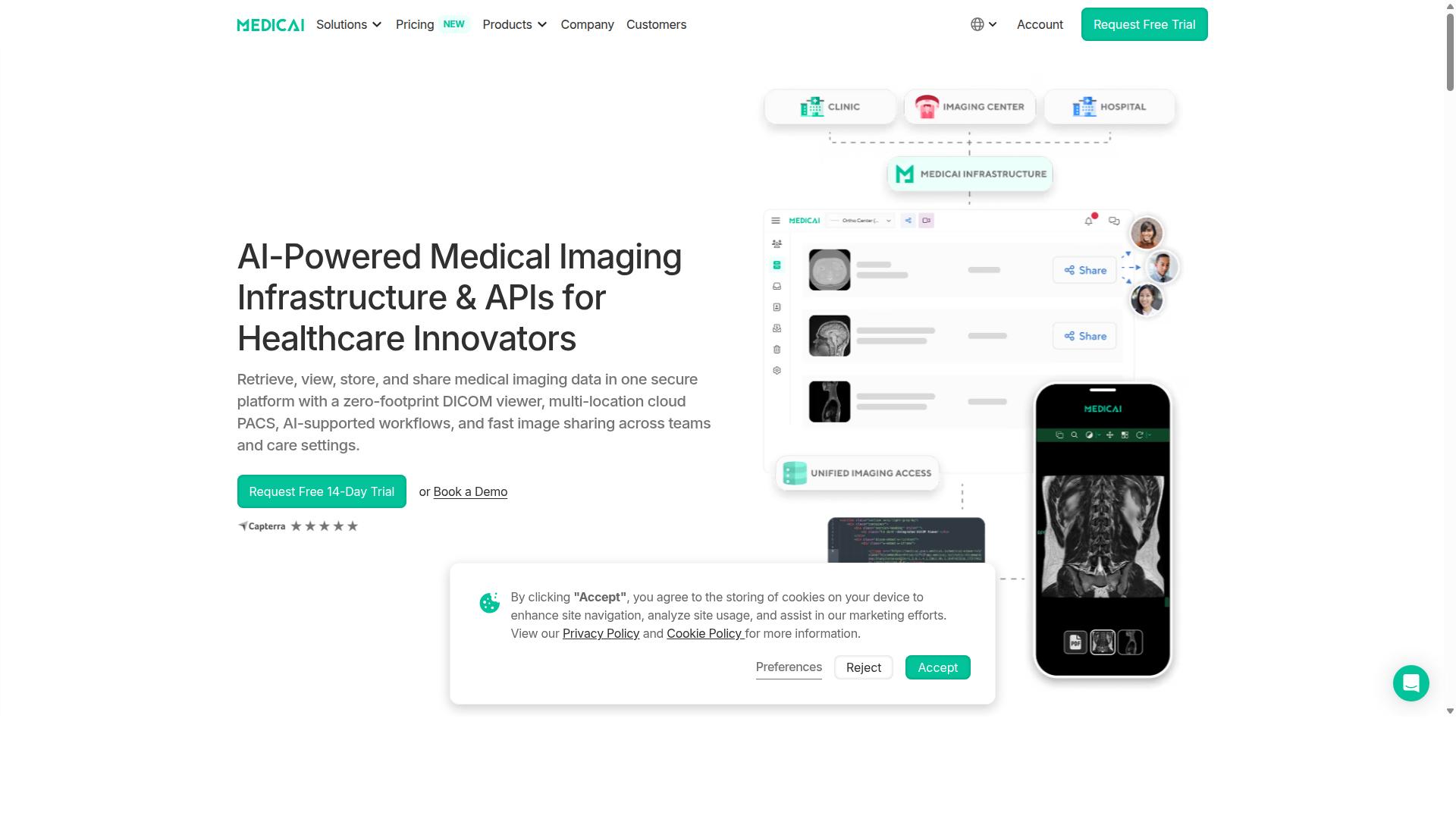
Medicai operates as a cloud-based medical imaging platform that retrieves, views, stores, and shares imaging data through a single secure interface.
The platform provides a zero-footprint DICOM viewer that requires no software installation on user devices. This approach removes traditional barriers that often slow down radiology workflows across different care settings.
Compliance stands as a core requirement for any medical imaging solution. Medicai maintains HIPAA, GDPR, and FDA/CEE compliance to meet regulatory standards that healthcare organizations must follow.
Scale matters when evaluating imaging platforms for enterprise use. The platform currently holds 1.7M+ studies in storage, demonstrating capacity to handle substantial imaging volumes across healthcare networks.
Medicai functions as Imaging Infrastructure as a Service, allowing organizations to modernize their radiology operations without managing on-premise hardware. This model supports multi-location cloud PACS deployments that connect imaging workflows across different facilities.
The platform enables AI-supported workflows that connect with existing radiology processes. Fast image sharing capabilities connect teams and care settings that need immediate access to diagnostic imaging studies.
What Is Intelerad?
Intelerad provides radiology workflow solutions generally positioned as enterprise PACS and RIS platforms for healthcare organizations. The platform focuses on managing medical imaging data and supporting diagnostic imaging processes across various healthcare settings.
Many institutions consider Intelerad when evaluating radiology informatics platforms. The company offers solutions that handle image archive functions and support clinical workflows in radiology departments.
Radiology teams often look for platforms that address image routing and study prioritization needs. Intelerad operates within this competitive space alongside other vendors in the radiology informatics market.
Healthcare organizations typically assess several factors when comparing PACS and RIS solutions. These include interoperability capabilities, workflow automation features, and integration with existing EMR systems through HL7 and FHIR standards.
Market positioning for Intelerad reflects its role as one vendor among multiple options in the radiology informatics sector. Organizations evaluate such platforms based on their specific operational requirements and technical infrastructure needs.
Features Compared
This section examines three critical feature areas where Medicai and Intelerad diverge in their approach to radiology workflow management.
Modern radiology departments face increasing demands for faster turnaround times and improved diagnostic accuracy. AI-assisted radiology requires seamless integration between existing systems and new intelligent tools.
Architecture choices impact how organizations scale their operations. Workflow automation depends on connectivity standards that allow diverse imaging environments to work together efficiently.
AI Workflow Integration & Automation
Medicai integrates AI tools through partnerships including Rayscape.ai and MD.ai, enabling automated study prioritization and triage workflows.
These partnerships allow radiology AI co-pilot functionality to assist with routine image analysis. AI-powered diagnostics support radiologists in identifying patterns across large image sets without replacing clinical judgment.
Automated study routing reduces manual sorting tasks that traditionally consume staff time. AI triage capabilities help prioritize urgent cases based on preliminary analysis results.
Intelerad follows traditional approaches to radiology workflow management without specific AI orchestration partnerships. AI-assisted radiology requires direct integration between diagnostic tools and existing PACS infrastructure to achieve meaningful productivity gains.
Cloud-Native Architecture & Scalability
Medicai's cloud-first design supports 1.7M+ studies in storage with automatic scaling through Microsoft Azure and Amazon AWS infrastructure.
The cloud PACS system eliminates hardware maintenance requirements while providing vendor neutral archive capabilities. Backup and disaster recovery features protect against data loss through distributed storage architecture.
Automatic scaling adjusts storage and processing capacity based on current demand levels. Image archive accessibility remains consistent regardless of organizational growth or seasonal fluctuations in study volume.
Intelerad typically relies on on-premise PACS installations that require dedicated IT resources for maintenance and upgrades. Radiology informatics benefits from cloud architectures that reduce infrastructure complexity while maintaining data security standards.
Interoperability & Multi-Vendor Connectivity
Medicai enables multi-vendor connectivity through HL7 and FHIR standards, supporting DICOM Gateway functionality for diverse imaging environments.
The medical imaging uploader and DICOM Gateway provide flexible data exchange options across different imaging modalities. Structured reporting for radiology maintains consistent documentation formats regardless of source systems.
EMR compatibility allows seamless integration with existing hospital systems without requiring extensive custom development. Medical image exchange capabilities support collaboration across organizational boundaries.
Intelerad supports similar connectivity standards while maintaining its established presence in hospital environments. Interoperability remains essential for organizations managing multiple imaging vendors and clinical information systems simultaneously.
Pricing Compared
Medicai offers transparent monthly pricing starting at $249 for 500 GB storage with unlimited user accounts and scaling to $749 for 2 TB with one connected location. This structure provides clear cost visibility for radiology departments evaluating workflow automation options.
Intelerad follows a traditional enterprise licensing approach that typically involves custom quotes based on institutional size, deployment scope, and feature requirements. This model often requires extended sales cycles and detailed negotiations before pricing becomes available.
Starter plan at $249 per month includes 500 GB cloud storage and unlimited user accounts without any connected location requirements. Organizations can test core AI-assisted radiology features through a 14-day trial period without providing payment information.
Standard plan at $749 per month expands to 2 TB of storage while adding one connected location for DICOM gateway integration. Yearly billing reduces these rates to $209 and $639 per month respectively, offering 15 percent savings for committed radiology practices.
Enterprise customers receive custom pricing structures that accommodate multiple connected locations and external site connections. Per-study pricing options become available at this tier for organizations with variable imaging volumes.
DICOM Gateway Setup requires a one-time $1,000 fee per location for both Standard and Enterprise plans. This connectivity investment enables secure image routing and workflow automation across different imaging modalities.
Intelerad customers often encounter opaque pricing models that obscure total cost of ownership until late in the evaluation process. Medicai's published rates allow radiology teams to calculate implementation budgets immediately and compare options without lengthy discovery calls.
The absence of partial period refunds means organizations should evaluate their workflow automation needs during the trial period. This approach encourages thorough testing of AI triage capabilities and integration engine functions before making financial commitments.
Who Should Choose Medicai
Healthcare providers seeking AI-assisted workflow automation and cloud scalability should evaluate Medicai for their radiology operations. Hospitals and imaging centers often face increasing study volumes that demand flexible infrastructure. Cloud deployment allows these organizations to scale resources without managing physical servers.
Specialty providers in radiology, cardiology, and oncology benefit from Medicai's ability to handle over one million annual studies. Global availability supports multi-site networks and cross-border teleradiology services. Organizations prioritizing AI integration find the platform designed to accommodate future algorithm additions without major system changes.
Interoperability remains critical when connecting existing PACS, RIS, and EMR systems. Medicai supports standard protocols including DICOM, HL7, and FHIR for seamless data exchange. This capability reduces manual data entry and helps maintain accurate patient records across departments.
Target users include virtual care providers, telemedicine platforms, and clinical trial coordinators who require reliable study routing. Tumor boards and medical education organizations also utilize the platform for collaborative case review. The patient portal extends access to imaging results for improved communication between providers and patients.
Research suggests that institutions with distributed teams value cloud-based solutions for consistent performance across locations. Medicai addresses this need by offering deployment flexibility while maintaining compliance standards. Organizations comparing options should assess whether their current infrastructure supports similar growth without additional hardware investments.
Who Should Choose Intelerad
Organizations with established on-premise infrastructure requirements may find Intelerad's enterprise radiology solutions align with their operational needs.
These arrangements often include existing hardware investments and internal IT teams that maintain physical servers. Traditional deployment models can match environments where data control remains a priority for regulatory or contractual reasons.
Enterprise scale healthcare systems sometimes operate under constraints that favor on-premise PACS and RIS configurations. Legacy system integration through HL7 or DICOM protocols may already exist, making incremental changes more straightforward than full platform replacements.
Research suggests that institutions with complex internal networks sometimes experience fewer disruptions when they retain familiar architecture. Workflow automation in these settings tends to focus on localized tools rather than distributed cloud services.
Multisite networks with dedicated data centers may also prefer solutions that operate within their own security boundaries. Image routing and case assignment processes can stay contained when infrastructure remains under direct organizational control.
Final Verdict
Medicai provides measurable advantages in AI-assisted workflow automation through 1M+ annual studies processed, 50M+ API transactions, and global cloud accessibility.
Study volume metrics demonstrate substantial capacity. Processing more than one million studies each year supports healthcare organizations handling high imaging demand. This scale positions Medicai as a reliable option for radiology departments seeking consistent performance.
API transaction capacity reaches more than 50 million per year. This capability enables seamless connections between Medicai and existing PACS, RIS, and EMR systems. High API throughput supports real-time data exchange required for AI-assisted radiology workflows.
Compliance certifications add another layer of confidence. Organizations handling sensitive medical imaging data benefit from verified security standards. These certifications address regulatory requirements common in diagnostic imaging environments.
Global cloud accessibility extends availability across multiple regions. This infrastructure supports distributed radiology teams working across different time zones and locations.
Healthcare organizations evaluating AI-assisted radiology solutions have clear next steps with Medicai. Contacting the sales team provides detailed information about implementation requirements and integration options. The USA office at 7901 4th St N, STE 300, St. Petersburg, FL 33702 can be reached at +1 (832) 220 1035. International inquiries may contact the Romania office at 53-55 N Filipescu, 5th Floor, Sector 2, Bucharest, 020961 through +40 316 305 875. Email communication is available at sales@medicai.org.